


Over the holidays my family and I traveled to Spain. As much as I love history, heading into this trip I knew next to nothing about where we were headed. No big deal, I’ll get up to speed in a hurry I figured.
Then the Iberian Peninsula slammed me over the head with two millennia’s worth of history like a sledgehammer.
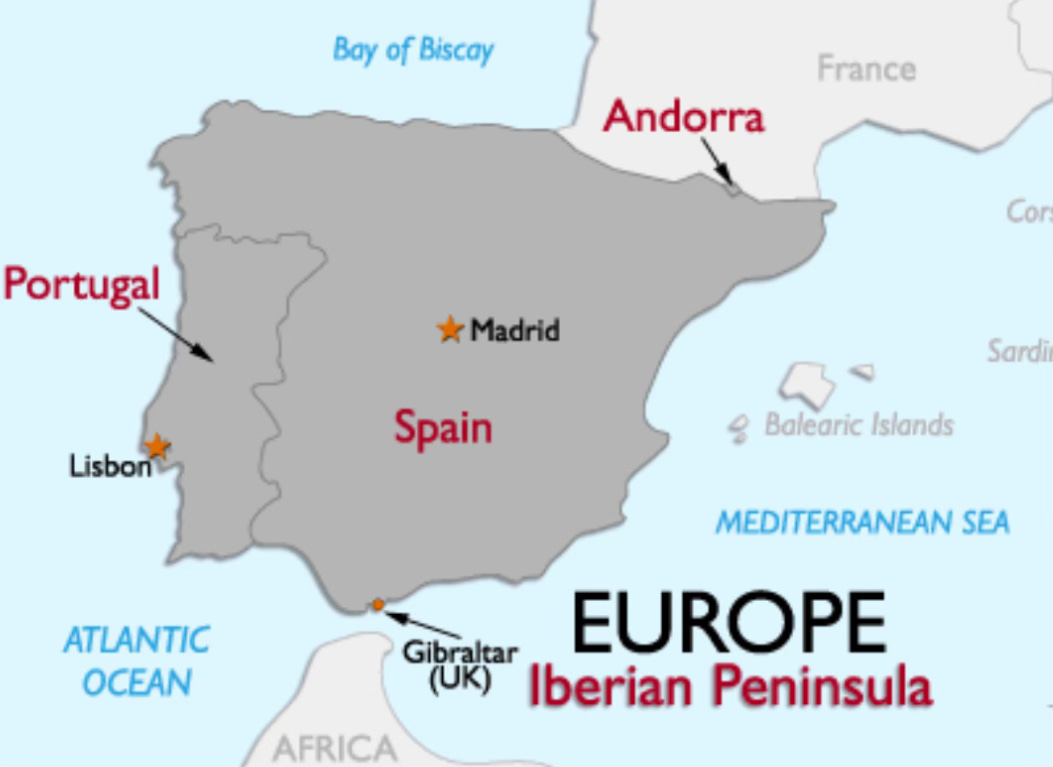
Here is a Cliff’s Notes version (If you are like my wife and hate history skip this part. I promise there is fun stuff a comin’!)
🇪🇸 Pre-Roman times: A mish-mash of peoples wander into the area. Essentially, European and Celtic in the North, Arabic Muslims in the South.
🇪🇸 Rome began it’s conquest of the Iberian peninsula in the 200s BC and had fully conquered it by the time of Jesus.
🇪🇸 As the Roman Empire crumbled in the 4th & 5th century, Germanic tribes took their place. One of our tour guides referred to these people as “barbarians.” Later we heard them referred to as Visogoths. Which is essentially just a nicer word for barbarian. Regardless, barbarian in that time simply meant “foreingers that don’t speak our language.” The fact that we now consider a barbarian as basically an uneducated animalistic person who destroys everything in his1 path is really just because of Roman people’s sour grapes. These ‘barbarians’ were the new kids on the block and Roman subjects, who had just lost their empire to them, didn’t like it.
🇪🇸 The Germanic tribes didn’t last very long (stupid barbarians).
🇪🇸 Arab Muslims from North Africa, commonly referred to as the Moors, took over around the 7th century. However, in the north of the peninsula, there were still a bunch of Christians.
🇪🇸 These Christians, feeling the whole Crusader-vibe going on at the time, continued to pester and murder their way southwards, eventually defeating the Muslims at Granada in 1492. That is where Queen Isabella and King Ferdinand come into play. And a young man named Christopher Columbus. More on them later.
Ok, enough with the learnin’, let’s get to the explorin’…
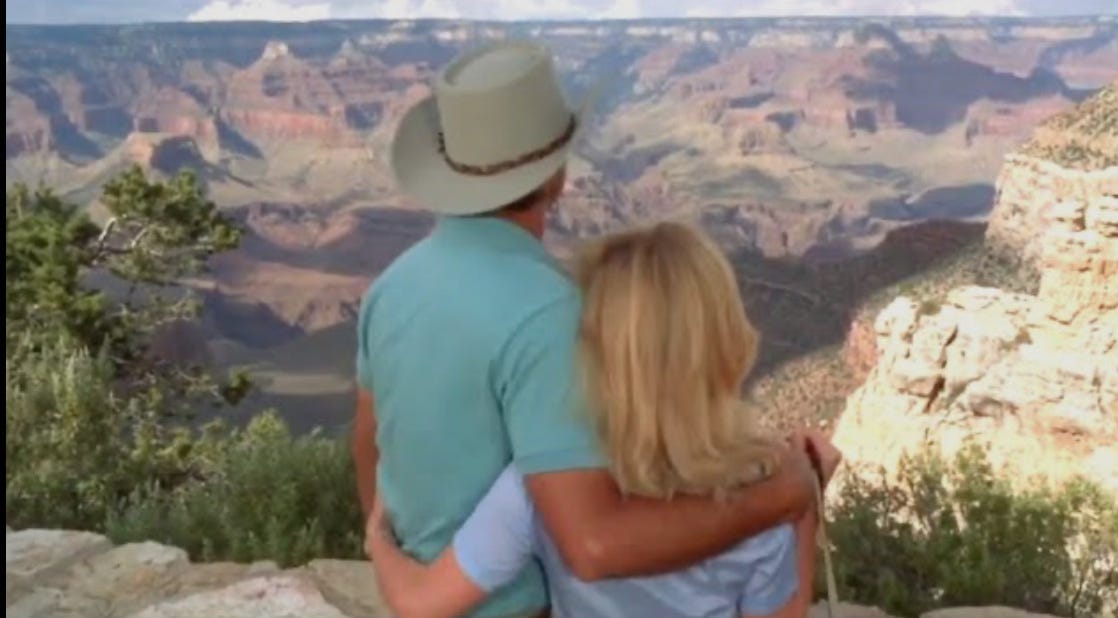
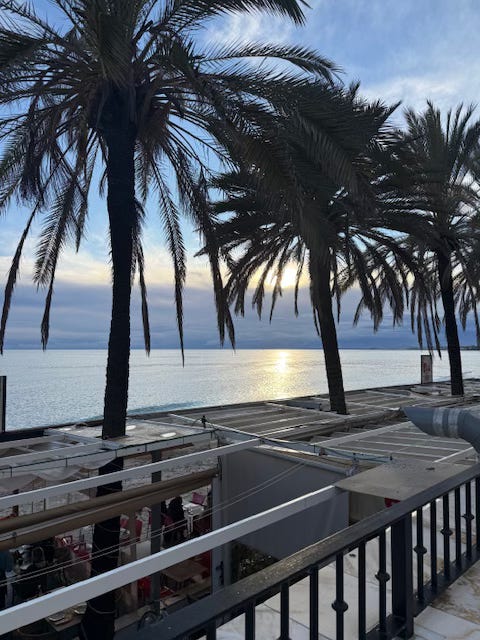
After 24 hours of travel our first stop was at a resort town in southern Spain along the Mediterranean, named Marbella. We started there basically for two reasons: First, to see the Mediterranean. However, it is winter in Spain now as well, so this is basically how we looked at the Mediterranean…
And, to visit the Rock of Gibraltar. The Rock makes up a large area of the landmass that is the country of Gibraltar, and it is at the very southernmost tip of the Iberian Peninsula. If you think the history I’ve given you so far has been convoluted, you ain’t seen nothin’ yet. I’ll be brief however.
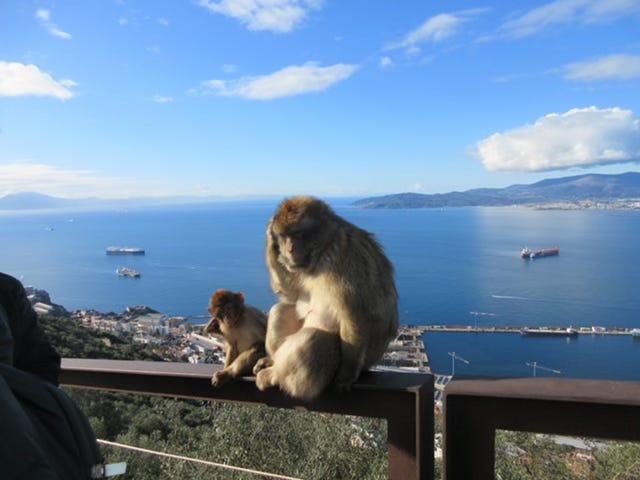
It is really difficult to show you in pictures just how impressive this rock is, and how high and steep it is. You can kind of tell in the picture above by the land below the monkeys how quickly the elevation drops off.


The coolest thing I learned about Gibraltar (it is actually a country…which encompasses the actual rock and the very tiny amount of land surrounding it) is the pre-history of it. Directly across the Mediterreanean from the Rock is Jebel Musa (Mountains of Moses), a small mountain rage in Northern Africa, in what is now the country of Morrocco. In ancient times these two areas were referred to as the “Pillars of Hercules.” Basically, this was the end of the ‘known world’ for Europeans and Hercules was protecting them from falling off the edge of the flat Earth.
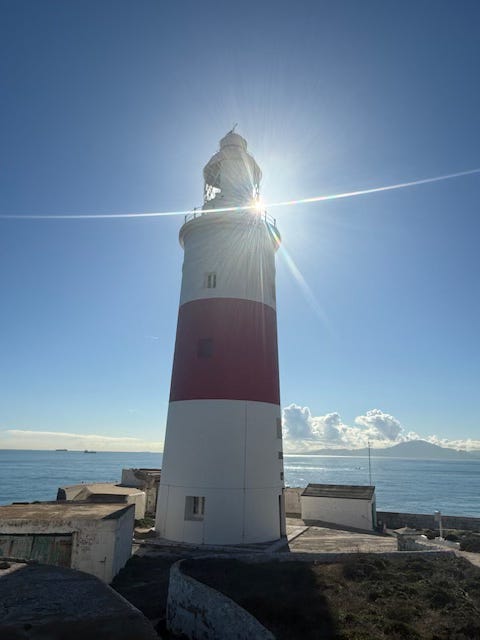
For centuries, if you controlled the Rock of Gibraltar, you controlled access to the Meditereanan sea…and all of the riches it led to. Control of the Rock basically followed the same patterns as the previous history we’ve discussed. That was until the Brits took it over during the War of Spanish Succession in 1704 (holy shit if you wanna confuse yourself Google that mess).
Up until that point Spain was kinda on the come up, and as a neophyte historian it strikes me that this maybe was the beginning of the end for them as a big dog on the world stage (we officially ended that shit with the Spanish-American War in 1898. Hashtag ‘Merica baby).
Either way, the Rock was spectacular.

(Ah yes, the monkeys. They arrived to the Rock most likely with the Moors around the 7th century as pets/food. Nowadays they are essentially just part of the tourist attraction. Their population is closely monitered, with the females all being on birth control.)
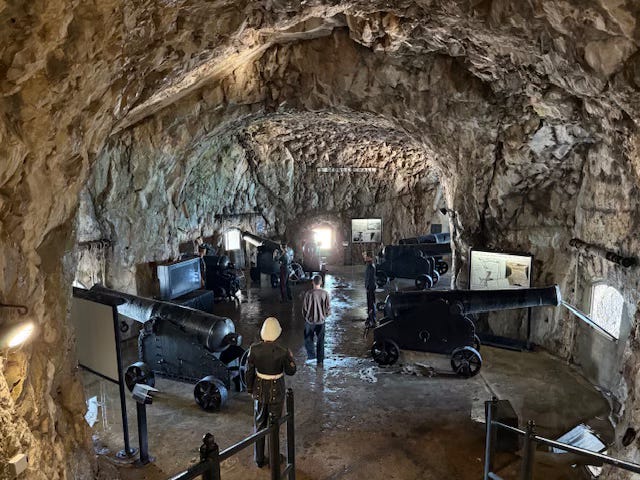
There is also a system of caves in the Rock, where I took this stunning video (watch with sound for the full effect)….
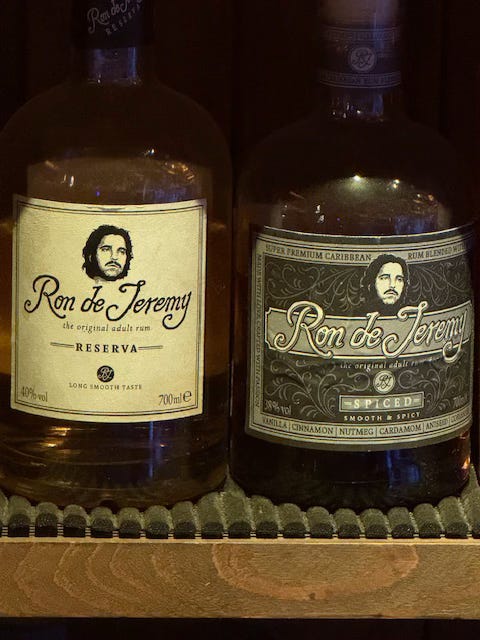
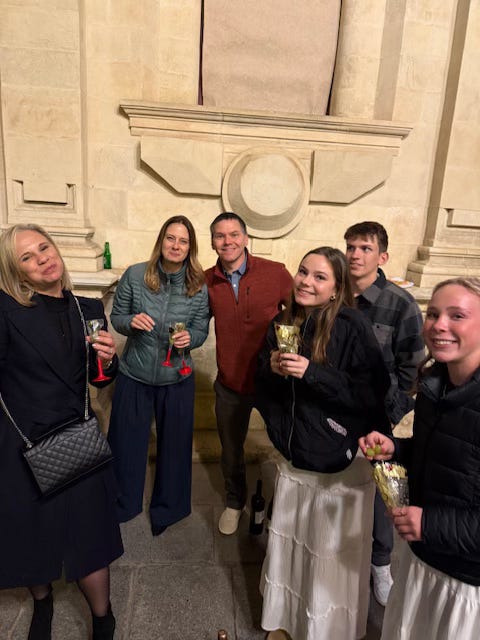
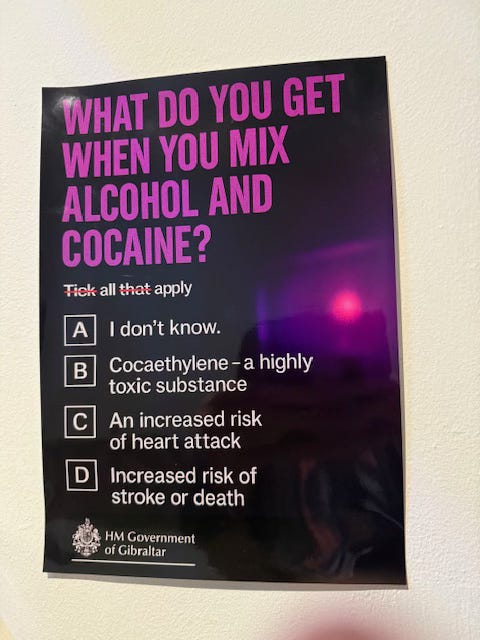
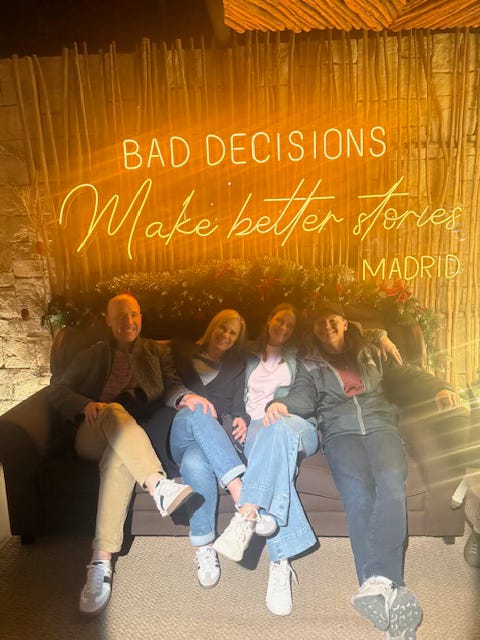
Later that evening we found ourselves in a local watering hole having an adult beverage. A few drinks in we noticed something else adult-themed:
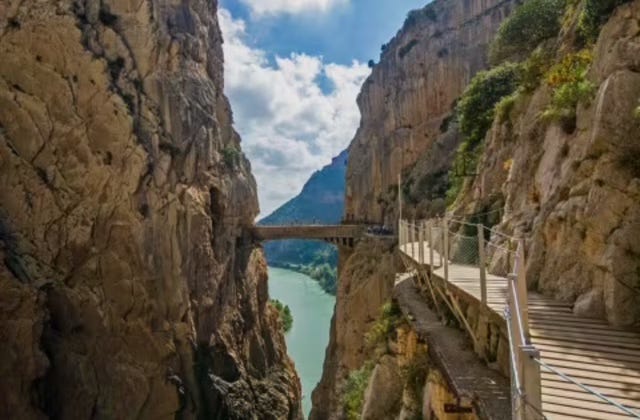
The day after visiting the Rock we were scheduled to hike the Caminito del Rey (Path of the King), which was located about an hour to the north of where we were staying. All I knew ahead of this hike was that a large chunk of it was attached directly to the side of sheer cliffs. This is the photo that literally woke me up in the middle of the night a few weeks before the trip:
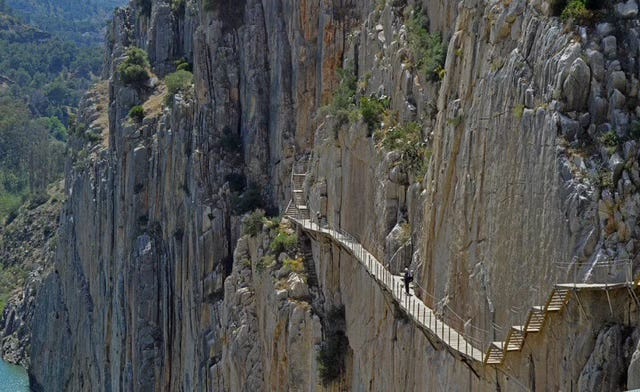
I’m not sure I’ve shared this little picadillo of mine, but I am afraid of heights. I’m anything if not a team player though, so away I went. This trail is what is left of the pathway workers used in the late 19th century in the development of several dams and a hydro-electric plant.
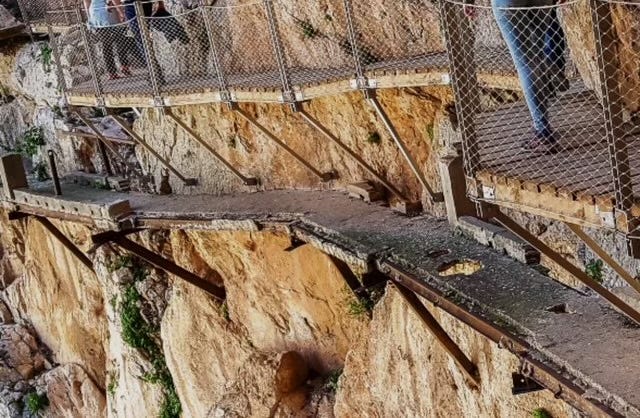
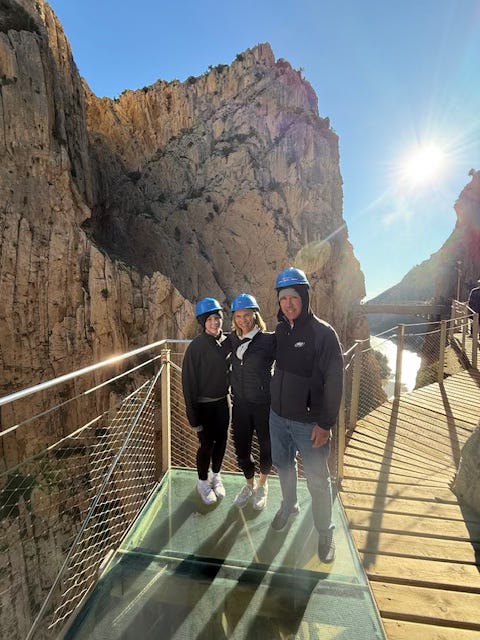
While I wish I could’ve enjoyed the walk as much as my family and friends did, I’m glad I went. Besides, the last time I begged out of an event like this because of my fear of heights it wound up biting me in the ass. (Take note: if you ever beg out of ziplining in Costa Rica do NOT go on the alternative hike. Unless you enjoy walking across swinging elevated bridges linking trees that make up rain forest canopy….a thousand feet in the air.)
One of the several running jokes my family has about me is the size of my head. I really don’t think it’s that big, but whenever we do an activity that requires some type of headwear, I can’t seem to find anything that fits.
The next day we made our way into the interior of Spain, to the ancient town of Seville (Savilla). The main highlights of our tour there were supposed to be the Alcazar (basically a fortified castle built by Muslims that Christians eventually took over), and the cathedral (which again was built by the Muslims and taken over by Christians). They were definitely cool…


But here were the things I found most intersting about the place:
Spain is a huge producer of Olive Oil. Did you know most of the “Italian” olive oil you buy is from Spain? Italy can’t produce enough, so they buy most of it from Spain, and then just re-label it as Italian.
Spain is the largest exporter of rice in Europe (it was Ukraine before Russia invaded).
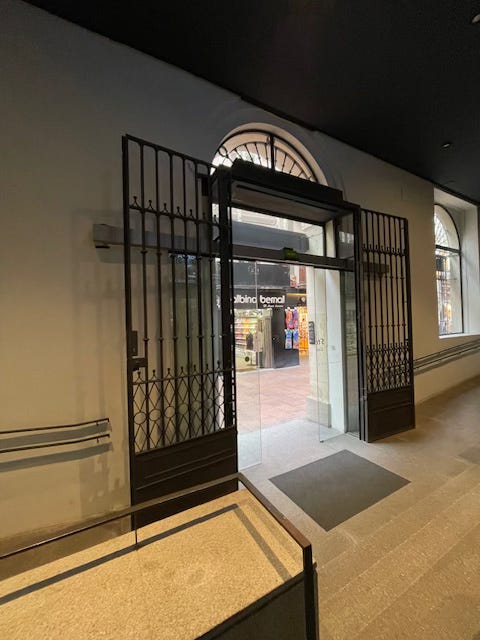
Miguel de Cervantes wrote the novel Don Quitoxe while in jail there. The jail is now a bank that we got to visit:
Our tour guide constantly referred to Christopher Columbus as discovering America. I withheld the urge to correct him repeatedly2, and I’m glad I did…more on that later.
The cathedral in Seville is the third largest cathedral in the world. Which I realized meant I’ve now been to all three (the other two are in Rome and London).
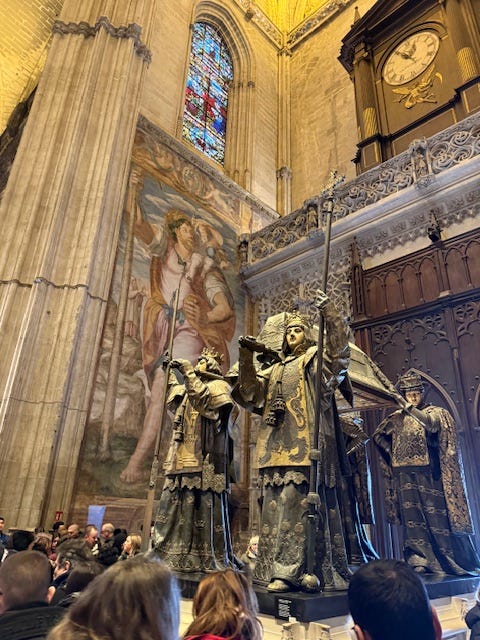
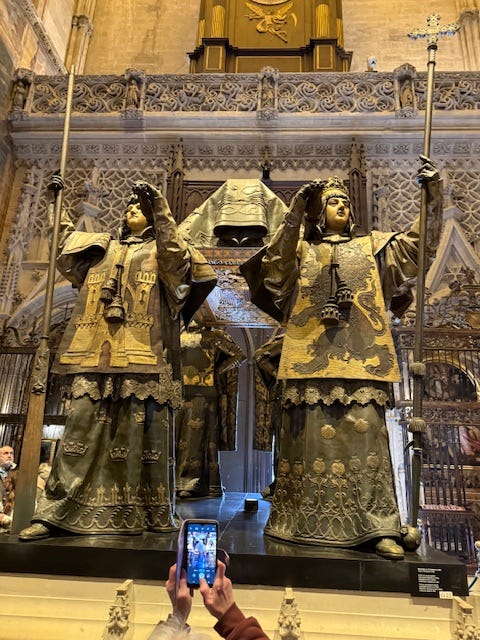
Christopher Columbus’s tomb is in the cathedral. Officials have twice in recent years taken DNA samples to verify that it was him. According to our tour guide the latest tests show that his lineage traces back to having Spanish ancestors (even though Columbus was from Italy). So now, said the tour guide, the Spanish take great pride in saying that Columbus was a fellow Spaniard.
(Sorry dude, but I don’t think it works that way. That’s like saying I’m officially Irish because 70% of my DNA is from there.)


Bull fighting is still a thing in Spain. The hotel where we stayed is important to locals because it is where the bull fighters go to dress when they are in town, “fighting.” The arena was right down the street.
Three kings day (Jan 6), is more important than Christmas. However, American capitalism has started to take over. So, Christmas is huge now as well (Santa and presents and all). So is Halloween, and even Easter. Our tour guide described Easter like this, “we used to just go to church, now we have, what you call it, hunting the chocolate? That is way better than just going to church.”
The last notable stop of our stay was the city of Toledo. It was absolutely incredible. The city seemed like the 1600s happened to it and never left. The original capital of Spain, Toledo was also really cool because it was an intersection of Muslim, Jewish, and Christian cultures. Until 1492 that is. With their victory over the Muslims, the Christians (Isabella & Ferdinand again) exiled the Jews and Muslims from the country.
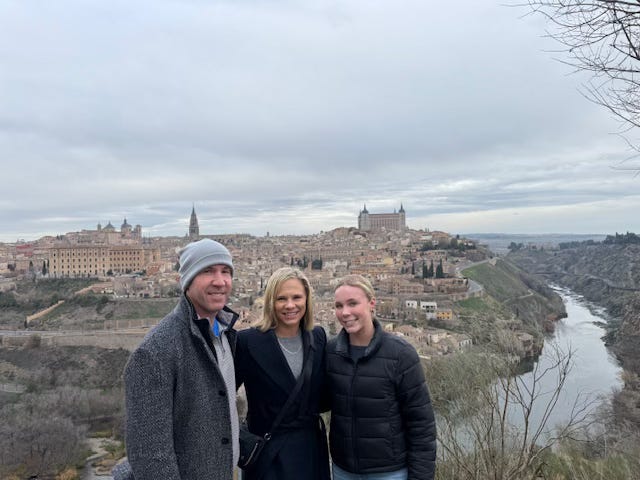
The Jewish population that was expelled are referred to as Sephardic Jews, and today the largest population of them is in Israel. But you can find them spread all over the globe as well.
🇪🇸
I took the picture below on Gibraltar (from the south, looking northwards), but I think it gives a good sense of what we learned and saw during our entire Spanish holiday…
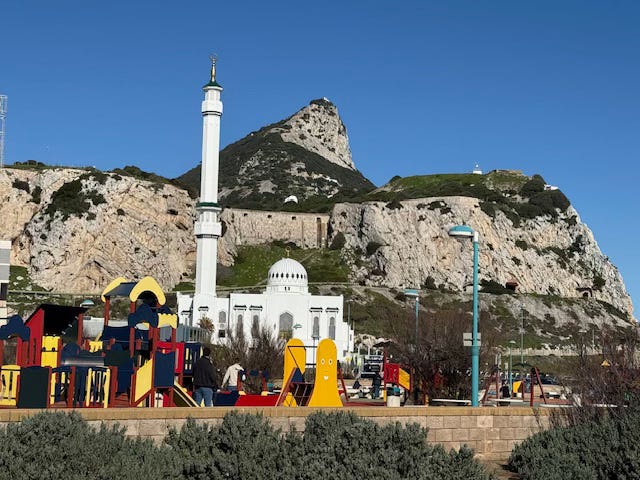
In the photo you can see the Rock in the background, then a Mosque, and then a modern children’s playground for the people that live in the area. To the left of this was a small soccer stadium. Thousands of years of history essentially sitting right on top of each other.
European culture is fascinating. In America we go to Disneyland and walk down Main Street and think that was the olden days. Seeing these places that go back thousands of years has really deepened my appreciation for cultures I really know very little about.
🇪🇸
Now, for some less deep thoughts:
Tipping culture: I much prefer the American way. While European servers seem to in general be having a better time at work, the level of service is noticeably lower.
We did however get a chance to see the oldest continuously operated restaurant in the world (in Madrid)…
New Years Eve Tradition: In Spain, the tradition of the twelve grapes happens on New Years Eve. Starting from twelve seconds before midnight you have to eat (or try to) one grape a second until the clock strikes 12.
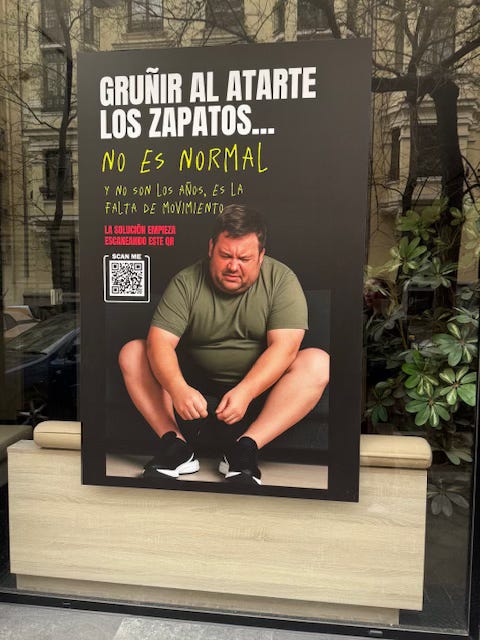
Saw some interesting signs…
Columbus and America. When Spanish folks refer to as America and Columbus, what they are really referring to is what we would call, ‘the Americas.’ I.E., Latin America. While we started to pick up on that earlier in our trip, we officially learned it the hard way in the Madrid airport in an effort to get back home.
We spent about 20 minutes in the “America” check-in line before realizing that wasn’t where we were supposed to be. Our line was simply called “US.”
All in all however, the decision to visit Spain was a good one.
Yes, “his.” Have you ever met a girl you’d refer to as a barbarian?
Columbus never set foot in the continental US.
I learned so much reading this - a mutual fear of heights, what Big Oil doesn't want me to know about the origins of olive oil, "Toledo" exists outside of Ohio, monkeys in Spain! Thanks for sharing and for the pics!
Lol 😆