


A Brief History of Men Avoiding Eye Contact With Each Other
Historians believe men first began bonding side-by-side around 12,000 years ago, shortly after discovering fire and shortly before refusing to ask for directions. Experts believe the average American male can withstand approximately 3.7 consecutive seconds of direct emotional eye contact before urgently needing to comment on the weather.
This behavior has persisted across nearly every era of human civilization. Men have discussed grief while repairing fences. They have processed heartbreak while untangling fishing line. They have revealed childhood trauma while staring through windshields, monitoring smoker temperatures, or pretending to be extremely interested in whether rain is expected later in the week.
Entire friendships have existed for decades on little more than shared activities, directional nods, and occasional observations about the stupidity of others.
For reasons scientists still do not fully understand, men appear significantly more comfortable discussing emotionally vulnerable subjects when both parties are jointly focused on a third object. Ideally, that object is moving, on fire, partially mechanical, or capable of causing bodily harm.
Throughout history, men have bonded while hunting mammoths, marching into war, grilling meat, and standing in garages holding beverages they consume at a pace best described as “supportive.” Face-to-face emotional transparency, meanwhile, continues to be treated by many American men with approximately the same caution normally reserved for unexploded ordnance.
And so, as with most strange and deeply ingrained male behaviors, we begin in the cold with two men walking side-by-side pretending not to have feelings.
The Hunter-Gatherer Era
Anthropologists believe the earliest examples of male emotional bonding emerged during prehistoric hunting expeditions, when small groups of men spent days walking side by side, tracking mammoths across frozen landscapes while carefully avoiding direct eye contact at all costs. Communication remained sparse and highly practical.
“Tracks.”
“River east.”
“Weather turning.”
Occasionally, however, one hunter would quietly introduce a deeply personal concern into the conversational ecosystem with the same tone normally reserved for discussing animal migration patterns.
“Think Greg’s marriage is okay?”
This approach proved evolutionarily advantageous. Early men discovered emotional vulnerability became significantly easier when both parties were jointly focused on a large woolly animal capable of trampling them to death. Direct face-to-face discussion, meanwhile, created obvious survival concerns, as it reduced the amount of time available for scanning nearby terrain for predators, collapsing ice shelves, or Greg accidentally provoking another mammoth.
Scientists now believe prehistoric men would rather have fought apex predators with sharpened sticks than begin a conversation with another man using the phrase,
“Can I be honest with you for a second?”
The hunting party itself functioned as an early prototype for nearly every modern male bonding environment that followed: fishing boats, golf carts, garage workshops, fantasy football leagues, and standing around grills pretending to supervise bratwurst.
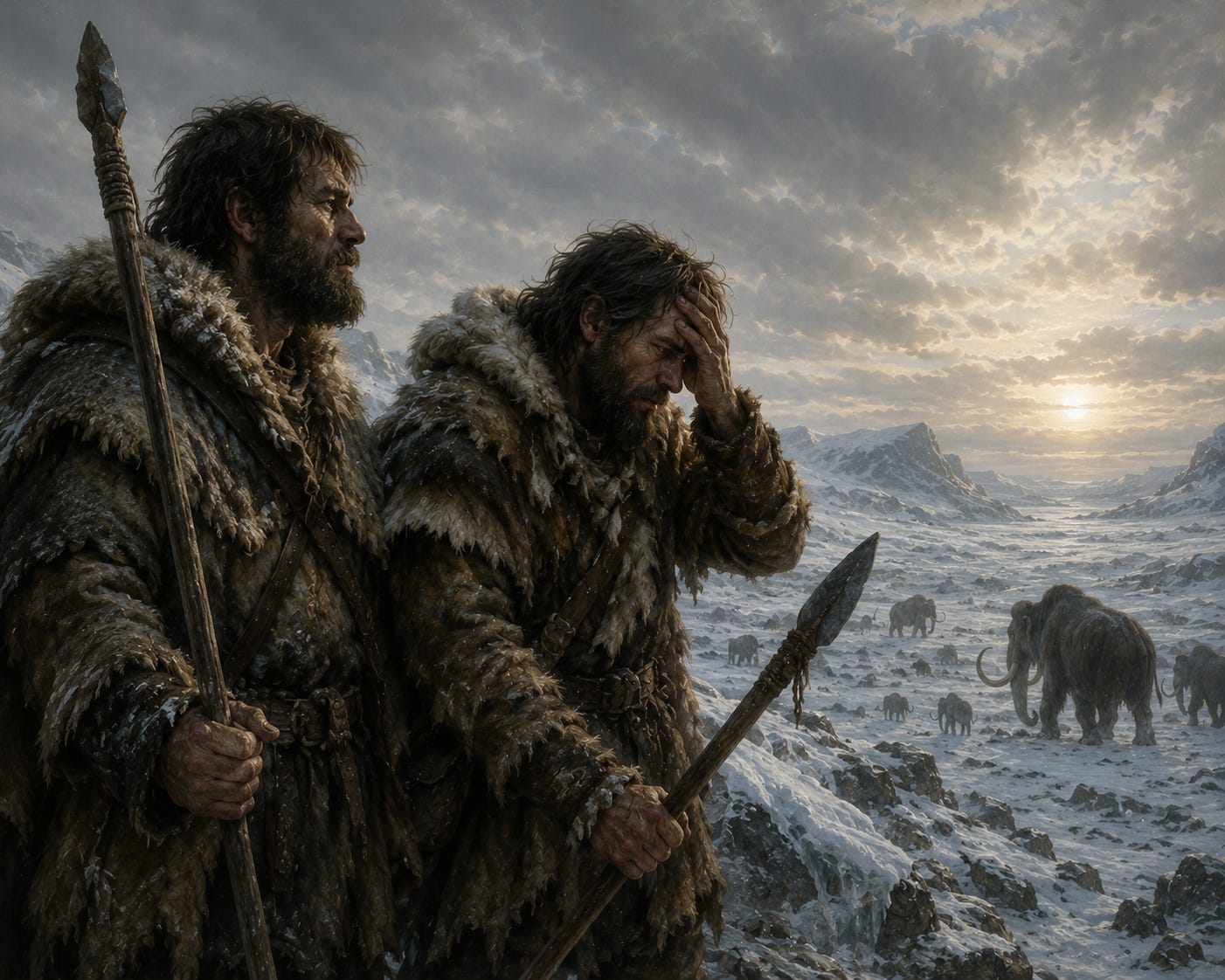
Somewhere around 10,000 B.C., two hunters likely stood overlooking a frozen valley silently contemplating mortality, purpose, and the crushing uncertainty of existence. After several minutes of silence, one man squinted into the distance and announced:
“Probably gonna snow.”
Emotional equilibrium restored, the hunt continued.
Ancient Rome
The Romans, of course, perfected this dynamic long before suburban dads began discussing mortality over Traeger grills. Historians believe Roman soldiers routinely processed the psychological horrors of war while standing shoulder-to-shoulder sharpening spears, repairing sandals, or preparing crosses for crucifixions. Rarely did anyone say, “I’ve been struggling lately.”
More common was something along the lines of, “Pass me the hammer,” followed by twenty uninterrupted minutes of silence best left unexamined.
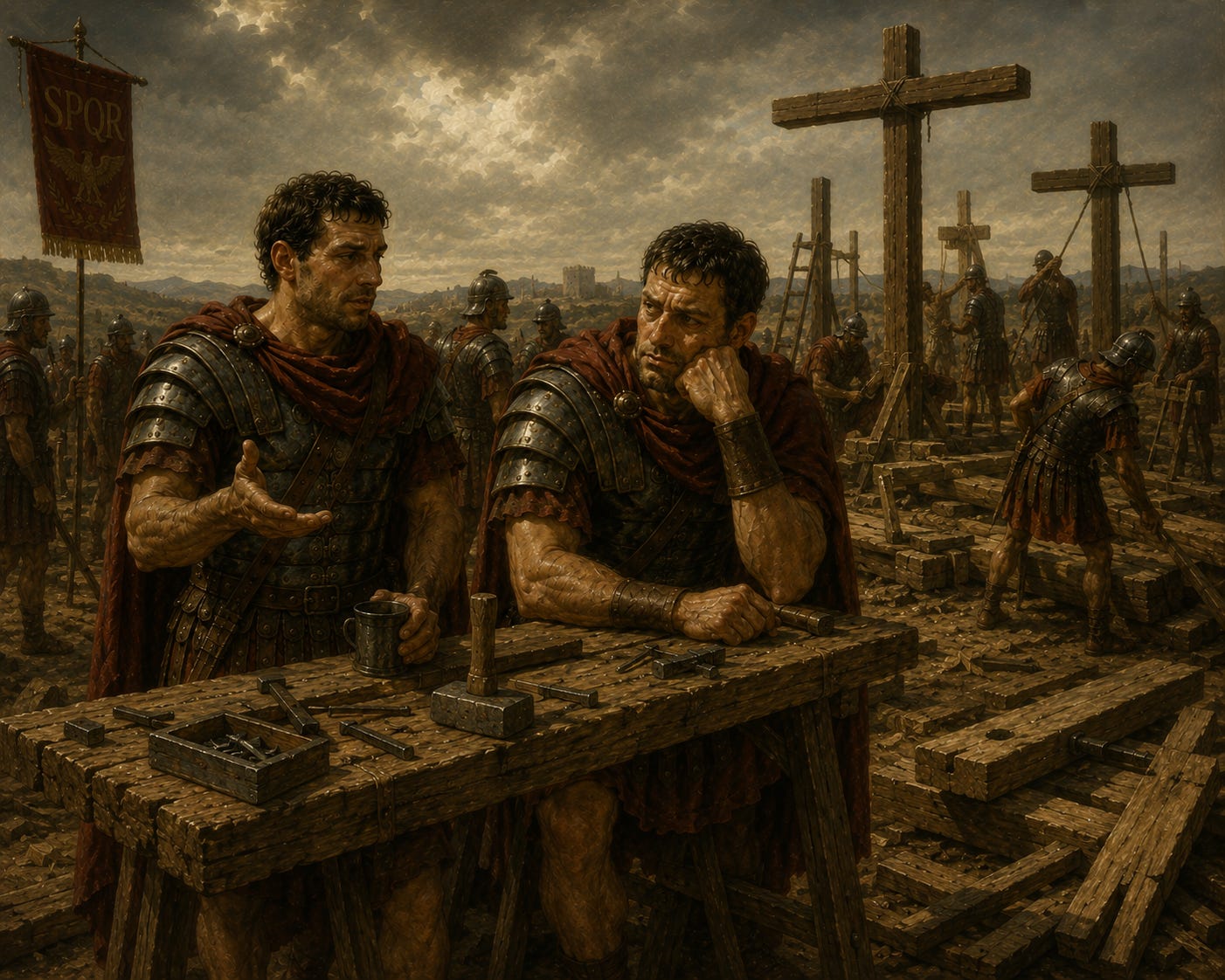
This arrangement suited everyone involved. Eye contact was minimized. Vulnerability could remain technically deniable. If a Roman centurion accidentally revealed too much emotionally, there were immediate escape hatches available, including discussing grain supply logistics, criticizing chariot traffic, or invading Gaul again for morale purposes.
Much like modern American men, Roman soldiers understood that difficult conversations became significantly easier when both men were technically focused on something else. In their case, unfortunately, that object was frequently a large wooden execution device.
Somewhere, undoubtedly, two exhausted Roman soldiers stood near a half-finished crucifix around 43 A.D., quietly trying to make sense of the accumulating emotional debris of empire. One finally muttered,
“You ever feel like none of this really matters?”
The other adjusted his nail pouch, stared firmly into the middle distance, and replied,
“So…bad news about Marcus’s goat, huh?”
The Industrial Revolution
By the time the Industrial Revolution rolled around, men had become remarkably efficient at converting emotional vulnerability into shared physical labor. Packed shoulder-to-shoulder into tenements and factories, they spent sixteen hours a day covered in soot, narrowly avoiding industrial dismemberment, and communicating almost exclusively through nods, coughing, and highly specific complaints about pulley systems.
Historians have long argued that labor unions emerged in response to dangerous working conditions. Increasingly, however, evidence suggests they were also one of the first socially acceptable ways for men to gather regularly and say things like, “You gettin’ tired too?” without triggering a full masculinity audit.
The early union hall functioned much like the modern sports bar or suburban garage.
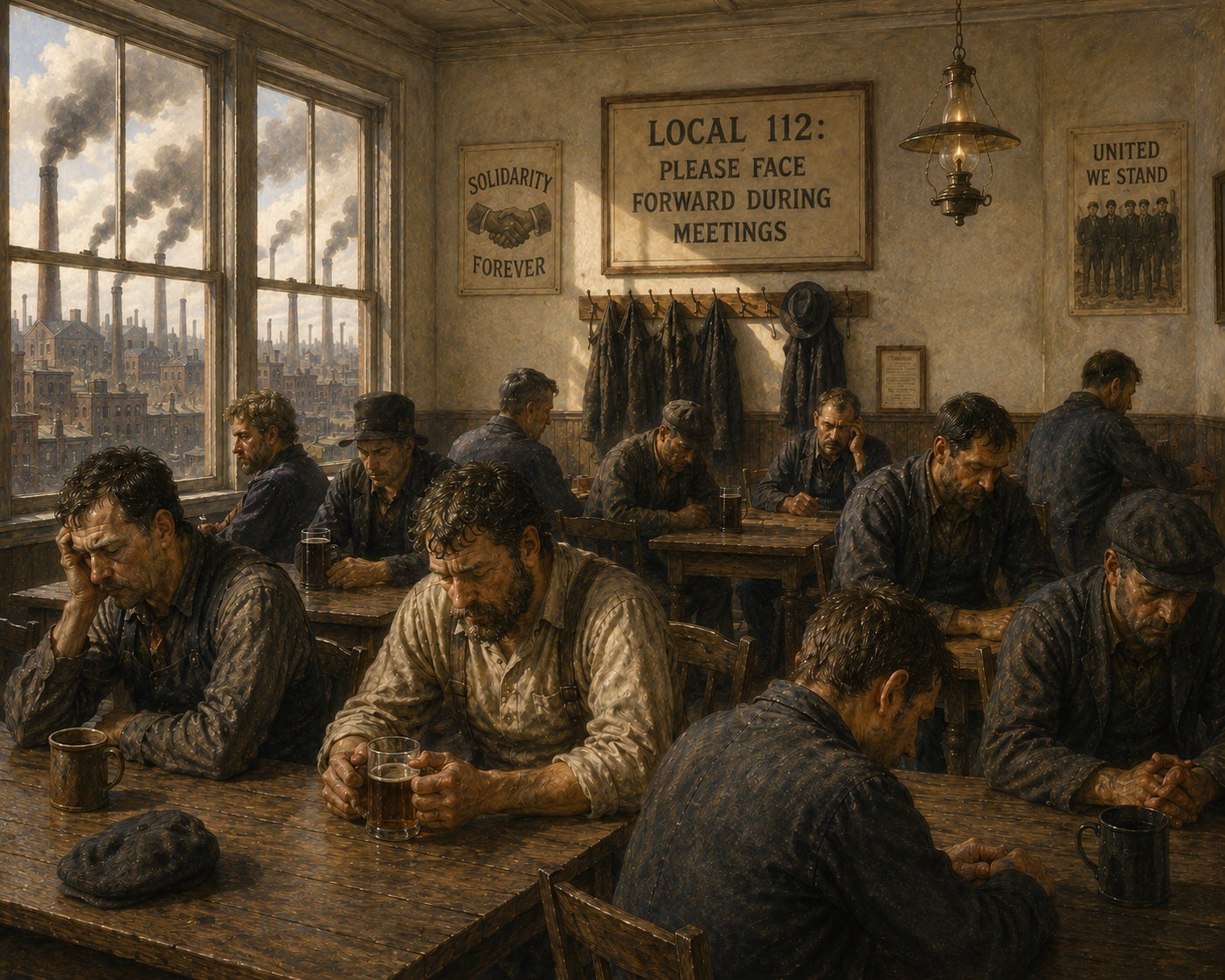
Men stood around holding beverages, discussing management with startling emotional intensity while technically pretending the conversation was about “work conditions.” In reality, many simply craved the revolutionary concept of being seen by another human being for more than fourteen consecutive seconds.
This explains why union meetings often lasted three hours, even though all actionable conclusions were reached within the first eleven minutes.
Meanwhile, tenement life dramatically accelerated the evolution of side-by-side male bonding. Privacy barely existed. Entire families slept separated by little more than curtains and tuberculosis. As a result, men developed advanced emotional survival tactics, including staring out windows while discussing financial despair, smoking silently on stoops, and taking extraordinarily long walks to nowhere…the original male wellness retreat.
Somewhere in lower Manhattan around 1891, two exhausted factory workers undoubtedly stood next to each other, stared into an alley, and briefly achieved emotional intimacy entirely by saying,
“Lotta pressure lately.”
The other man nodded once, spat into the street, and replied,
“Yep.”
Post-WWII America
American men returning from WWI, WWII, and Vietnam had legitimate reasons for staring at the garage fridge instead of each other during emotional conversations. Today’s men mostly inherited the posture without the artillery. At this point, our inability to connect face-to-face feels less like PTSD and more like an evolutionary vestigial tail.
As the decades passed, men became extraordinarily innovative in creating environments where emotional intimacy could occur accidentally. Basements, garages, tailgates, and ice-fishing shacks all emerged as safe spaces where a man could briefly discuss mortality before immediately commenting on propane levels.
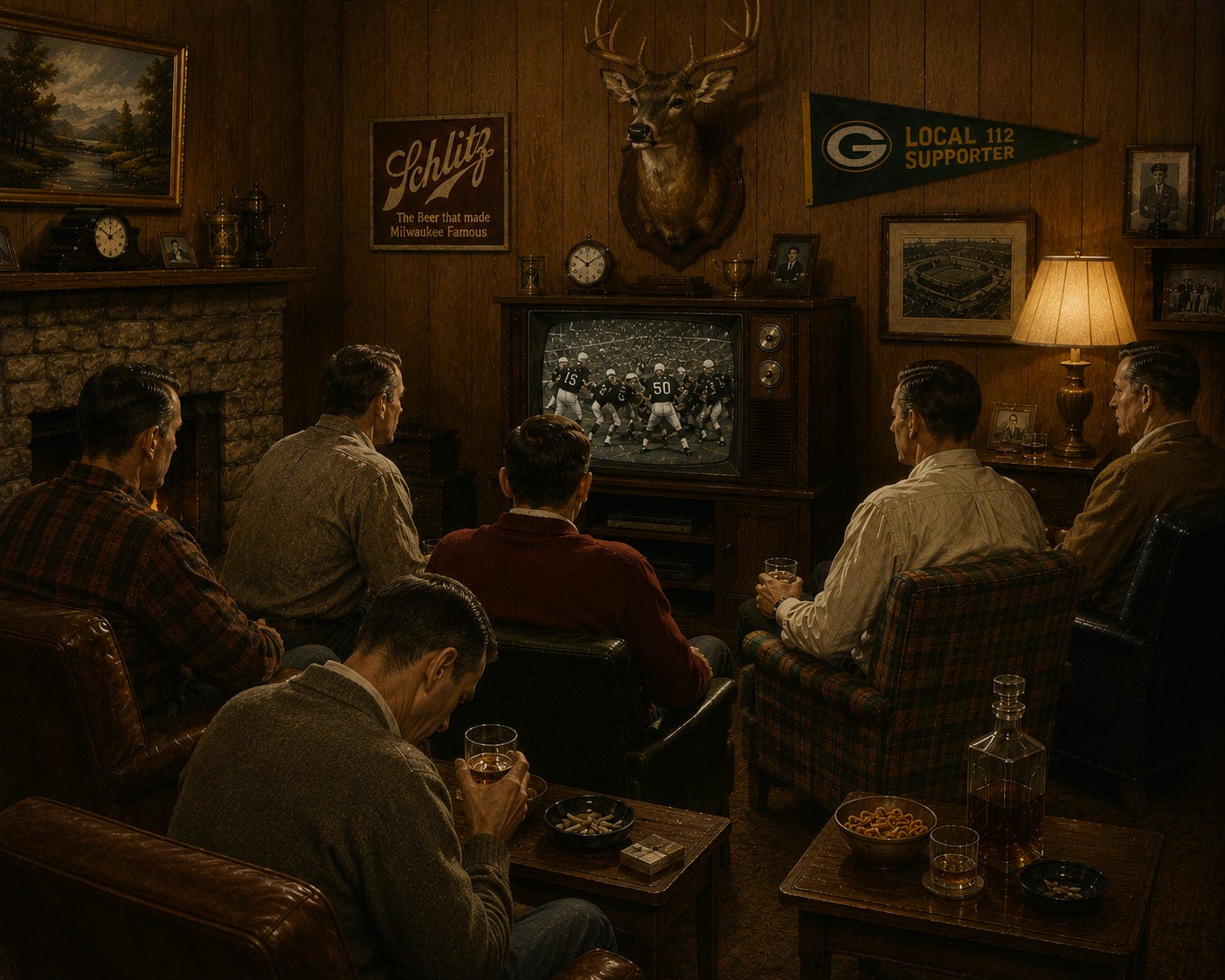
In Wisconsin, the basement bar is less a room than a cultural institution. Half tavern, half family bunker, it’s where generations gathered for Old Fashioneds, Packers games, fish fry overflow, and emotional conversations conducted almost entirely while staring at a mounted deer instead of each other.
Peeing Into The Future
By the 1970s, American men1 had achieved extraordinary technological advances. We’d landed on the moon, split the atom, invented color television, and developed the ability to microwave Salisbury steak in under four minutes. And yet, despite all this progress, public bathrooms across the Midwest still operated under the assumption that what men truly wanted while urinating was the looming threat of accidental eye contact.
When I first moved to Wisconsin, Camp Randall Stadium still featured the old trough-style urinals: long communal basins separated by a half wall, with another row of men directly opposite you. This arrangement effectively transformed peeing into a low-level psychological endurance exercise.
Thankfully, the restrooms have since been updated. Somewhere along the line, Wisconsin taxpayers eventually decided that if they were going to publicly fund an 80,000-seat football stadium, they could at least ensure Brad from Manitowoc didn’t have to drain twenty-five dollars’ worth of Leinenkugel’s while accidentally locking eyes with Frank from West Allis across a municipal piss aqueduct.
Modern bathroom design, thankfully, reflects decades of emotional and architectural progress. Today’s side-by-side urinals feature carefully engineered divider walls, forward-facing positioning, and just enough personal space to allow every man in the room to pretend he has entered into a private legal agreement with the wall.
Direct eye contact while peeing at Camp Randall now requires a deliberate ninety-degree head turn, an act generally interpreted either as a Mad Men-era corporate dominance maneuver or the opening stages of a criminal investigation. The rules are simple: Eyes forward…say nothing…see nothing. Pretend every other man in the room is merely a rumor. The entire system functions less like plumbing and more like mutually assured emotional disarmament.
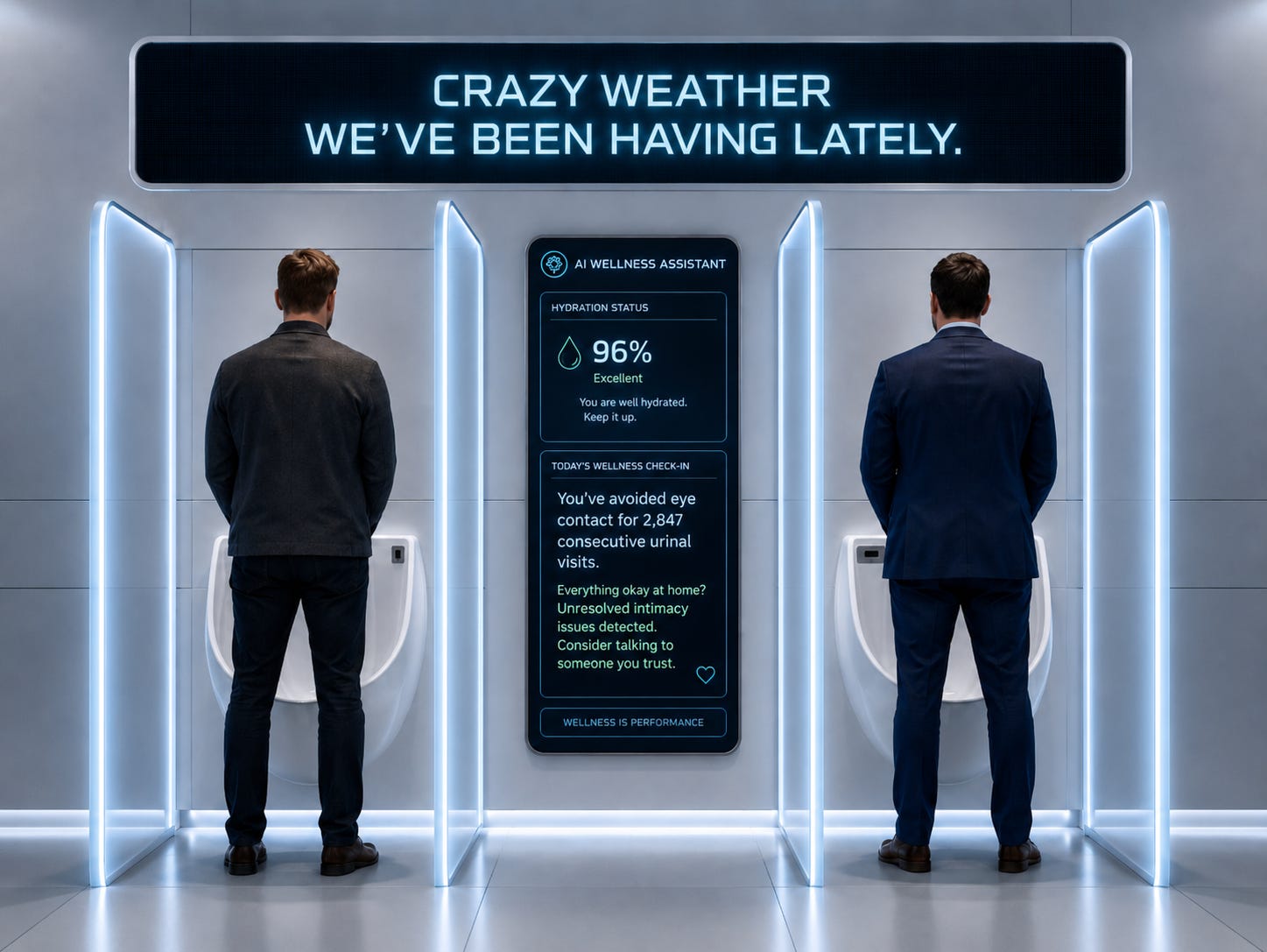
And yet, even as we race toward the future of artificial intelligence, autonomous vehicles, and robot-assisted surgery, male emotional architecture remains stubbornly prehistoric. However, someday soon, a man will step into a fully automated restroom where an AI assistant scans his hydration levels, predicts kidney stone risk, and politely reminds him he has unresolved intimacy issues stemming from seventh-grade basketball.
Even then, he will still stare straight ahead at the wall-mounted advertisement above the urinal and say, “Crazy weather we’ve been having lately.”
Civilization may evolve.
Technology may advance.
But American men, apparently, will continue solving vulnerability with infrastructure.
And women.
Nice travel through time, avoiding essential themes. This made my afternoon.
I love this piece so much. I wish I wrote it. I hope you don’t mind if I link to it in my next installment of my male friendships series.