


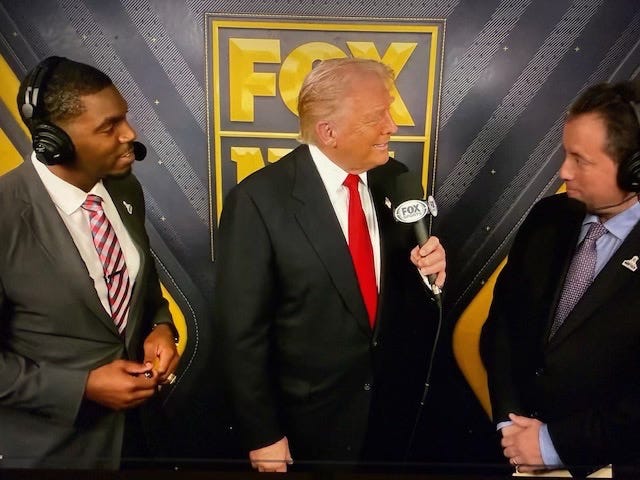
If you’re wondering if the first thing the leader of the free world did when talking to the country on Sunday Night Football was to throw his high school quarterback under the bus….you would indeed be correct.
Last week I was interviewing a widely respected professor and author on the topic of masculinity. I wanted to pick his brain on some specifics of masculine development for men born between the 60s and 90s. I know I have my experiences, but the book I am working on requires me to project my opinions of masculinity onto another person. A person I’ve never met and can never meet.
So, I wanted to see if I was on the right track.
In the middle of the conversation I had one of those ‘a-ha’ moments. No, not one of these….
The moment came when he described the idea of ‘bonded intimacy’ to me. And no, this is not the type of intimacy that requires a safe word. It’s referring to certain friendships. Ones where your relationship with someone is built entirely around a shared interest or activity.
For instance, let’s say you love pickleball. You play 2-3 times a week, often with the same group of friends. Afterwards you may even have a beer or share a meal together. The conversation revolves around jobs, families, and of course, pickleball.
But the conversation never goes deeper.
Kevin never talks about being in an unhappy marriage. Paul never opens up about the stress he feels caring for his adult autistic son. And Scott keeps the stress of being passed over for a promotion at work, yet again, to himself.
There is emotional risk involved for all three of those guys if they were to share their deeper feelings and struggles.
“Will I make things uncomfortable?”
“They all come here to escape their problems, I shouldn’t burden them with mine.”
“Will they think less of me?”
This same thing holds true for one-on-one friendships. While it may be easier to bring stuff like this up to a friend on an interpersonal level (because there isn’t fear of group embarrassment), it may actually sometimes be harder one-on-one. If your feelings are not listened to by the group, you can just blow it off as the dynamics of the group.
But if you put yourself out there with a close friend and they just laugh it off? Well, then you know this person truly doesn’t care.
And sometimes that’s fine. We don’t all need a million ‘great’ friends in our lives. And I think we’ve all had that clingy friendship that at some point we’ve had to extricate ourselves from.
That is not comfortable. Or fun.
And we certainly don’t wanna be that person.
One of the things I do on mornings that I write is read a little bit. Sometimes it’s just a book I’m interested in, sometimes it’s research, and others it’s a book that helps bring me inspiration. I knew I wanted to write about the concept of bonded intimacy this week. But I wasn’t exactly sure how.
So I picked up Rick Rubin’s The Creative Act for inspiration. I read from it often. It has really short and unrelated chapters, but that are super thought provoking. I can just open it up to a random page, read a few chapters, and all of a sudden my writing juices are flowing.
A few days ago I opened to a chapter called Listening. I’ve read this book before and have highlighted certain parts, but didn’t remember this particular chapter. I don’t know if it was serendipity or dumb luck….but the chapter was totally about bonded intimacy.
In a way.
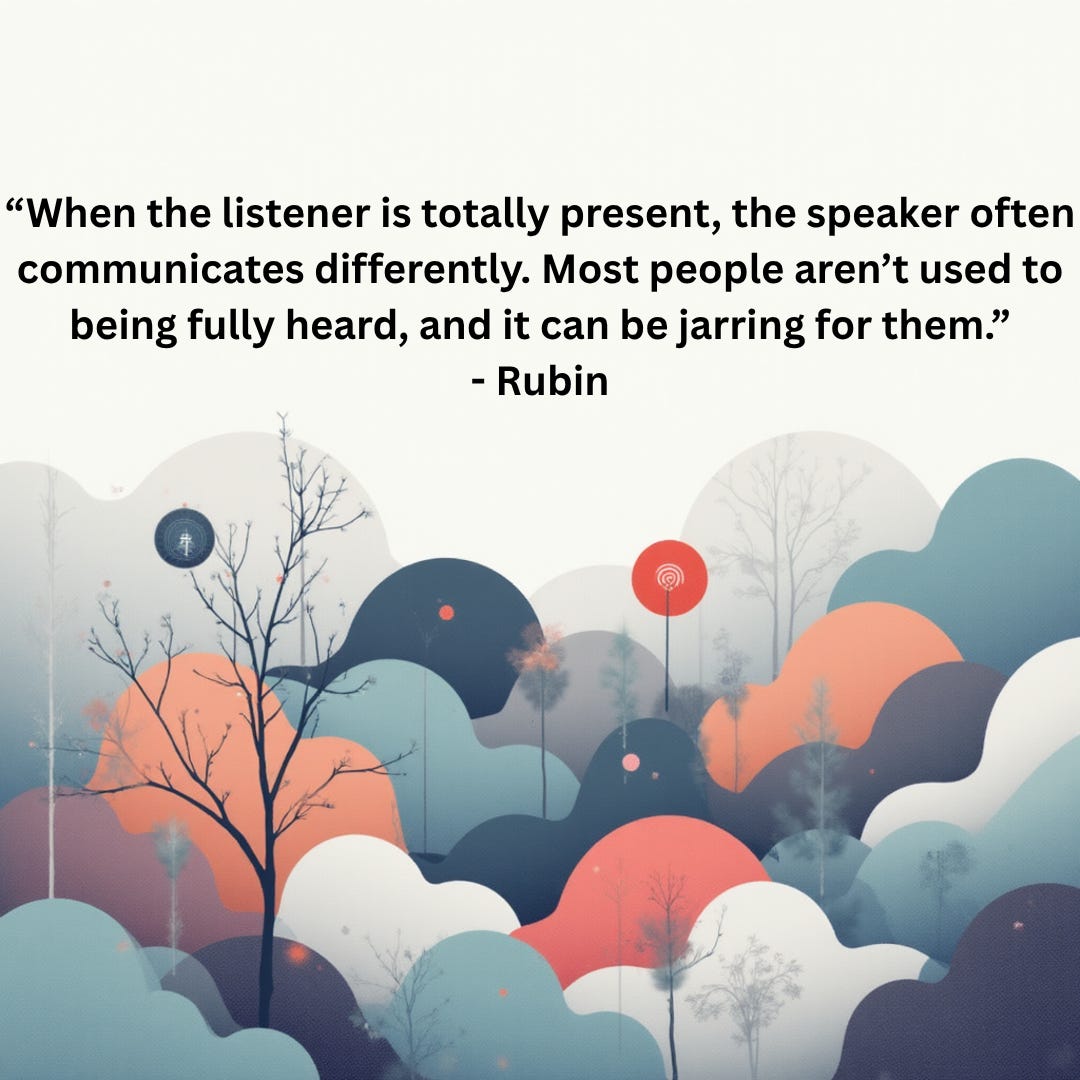
Have you ever had this experience? You’re out somewhere socially, or for work, and having standard, run-of-the-mill conversations. Then, in an instant, you’re talking to someone and it’s totally different. Like, “Oh, this person is listening. Really listening.”
It can be a shock to your system. It may even take you a few minutes to adjust, but quickly the conversation is more engrossing and enjoyable than all of the others combined.
Some people are naturally gifted in connecting with others in this way. Bill Clinton is a great example.1 Last year I heard a story about his amazing capacity for connection:
There was a boy, let’s call him Chris, who was in elementary school in Arkansas at the time Clinton was governor of the state. Clinton was visiting his school, as politicians do, and happened to stop by Chris’s classroom. It was a huge deal. Clinton came in with a big entourage, and young Chris could tell what an important man this guy must be.
Chris’s classroom had been working on a project called, “What do you want to be when you grow up.” When Chris’s teacher shared that with Clinton, the future president said, “Why don’t we ask some of the students what they want to be?”
With that, Chris’s teacher unexpectedly called on him first. Chris was ten at the time, with no clue what he wanted to be when he grew up. So he quickly looked around, remembered what a big deal this guy at the front of his class was, and blurted out, “I wanna grow up to be you.”
The adults in the room chuckled, and the visit came and went without further ado. Fast forward fifteen years. Clinton was president, and Chris was an adult working in Arkansas. Arkansas had just been hit by a devastating storm where tornadoes laid waste to several communities. Chris had volunteered to help clean up one of those communities when one day he heard President Clinton would be coming to town personally to thank the volunteers.
Folks in the area heard the president would be speaking in a different part of town, but would be driving by where Chris was working. When the time came for the presidential caravan to drive by, all of the volunteer workers lined the streets to watch. Unexpectedly, the caravan stopped a few blocks from where Chris and his co-workers were standing.
The president got out and started walking. He walked from one side of the street to the other, shaking hands and having brief chats with some of the people lining the streets. Suddenly, he crossed the street one more time and seemed to be walking in the direction of where Chris was standing. Closer and closer he came until Chris and the President were right in front of each other.
Chris could instantly tell that the President recognized him. Clinton extended his hand to Chris, shook it, then leaned in and said,
“So, you still wanna be me when you grow up?”
Some of you may remember the 1988 vice presidential debate, when goofball Dan Quayle compared himself to Jack Kennedy (JFK’s nickname). To which his opponent, Lloyd Bentsen, replied, “I knew Jack Kennedy. I served with Jack Kennedy. Jack Kennedy was a friend of mine. Senator, you’re no Jack Kennedy.”2
Well, if I am Dan Quayle in this scenario, I can honestly say I am no Bill Clinton. I have a hard enough time remembering what my wife asked me to do five minutes ago.
But I can try.
I can be better.
I can look people in the eye and truly listen. And when they share their vulnerabilities with me, I can receive it without judgement.
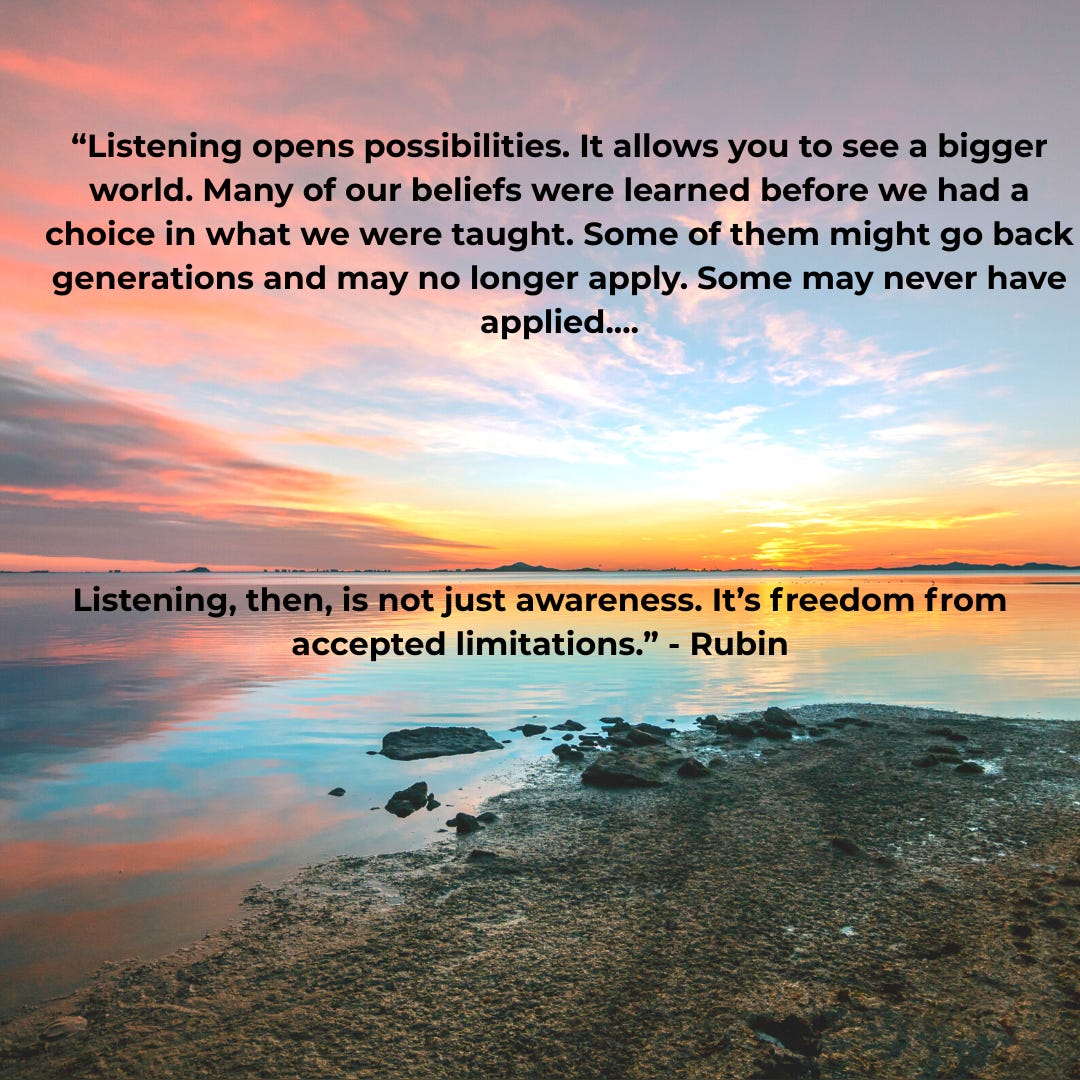
There are so many middle-aged people that crave relationships like they had when they were younger. Ones where they connected deeply with their friends. If you know someone like that, maybe share this with them…
A great example of this. Monogamy? Not so much.
Goddamn Lloyd, shots fired!!!. Let’s get politicians back who can humiliate each other like this!
I've heard stories about both Clintons remembering names. Bill has a photographic memory and politicians learn the art of how to remember names. Great piece.
Hahaha, what a headline! The rest was also quite enjoyable!